
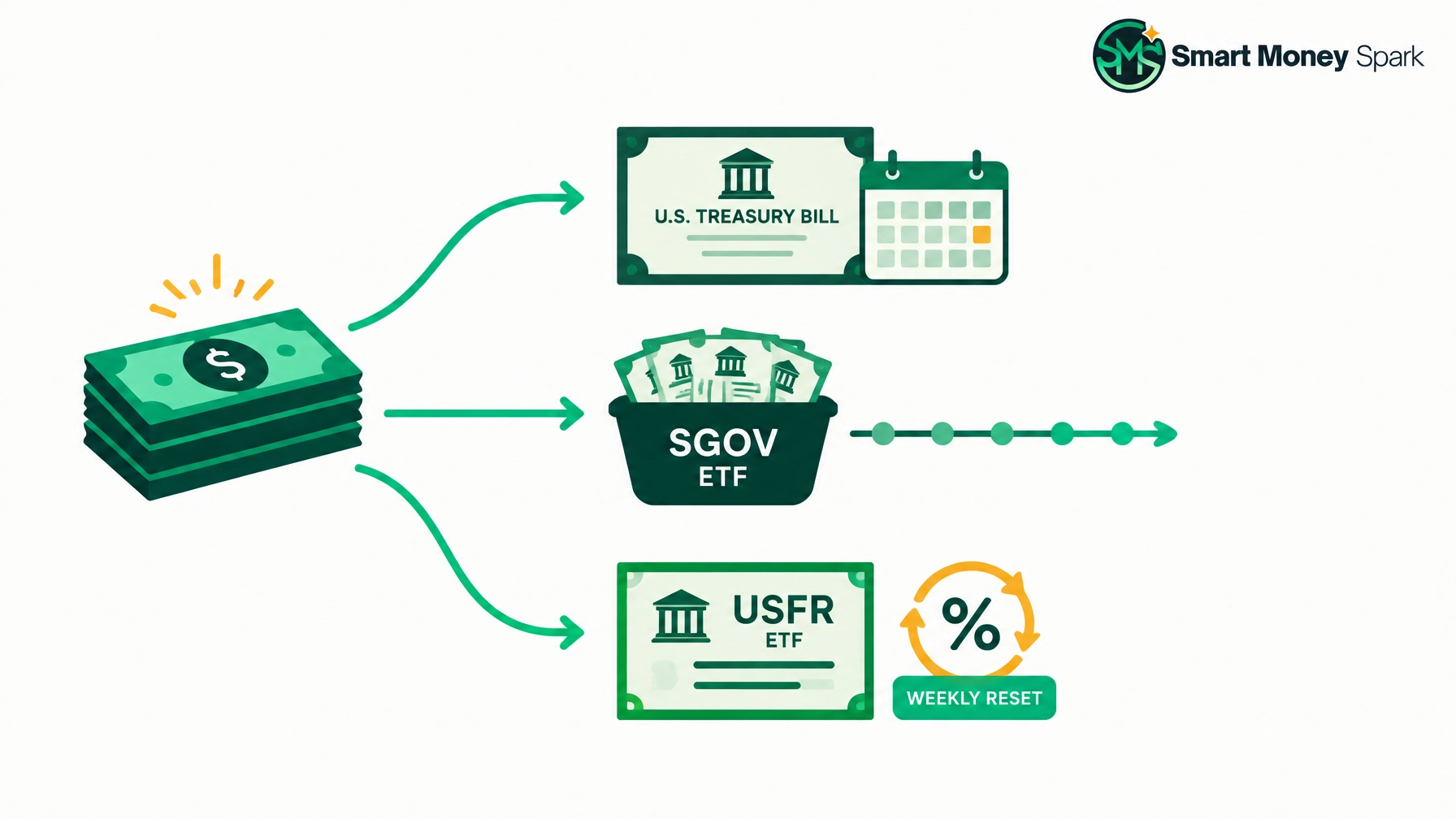
Direct T-bills, SGOV, and USFR offer different ways to hold short-term Treasury exposure.
If you’re deciding where to hold short-term cash, the choice isn’t just about the highest quoted yield. You’re weighing fund fees and convenience against maturity control, tax paperwork, and how quickly you may need to access the money.
Here’s the short version: direct T-bills avoid fund fees and have clear state-tax treatment, while SGOV and USFR package Treasury exposure in an exchange-traded fund (ETF), which you can buy and sell during market hours. Neither ETF nor an individual bill is a bank deposit, and none is guaranteed to maintain a fixed value if you sell before maturity.
Data note: Fund figures below are dated November 2026 where specified; yields and holdings change. The $100,000 calculation is a separate hypothetical example, not a quote of current yields.
1. The Core Trade-Off: Management Fees vs. Manual Reinvestment Friction
An expense ratio is the annual fee a fund charges as a percentage of its assets. SGOV’s expense ratio is 0.09%, or about $90 a year per $100,000 invested; USFR’s is 0.15%, or about $150. Both fees are reflected in fund performance rather than billed separately.
Direct Treasury bills have no fund expense ratio. You choose a bill’s maturity and hold it until the government repays its face value, or sell earlier through your broker. But when a bill matures, you must decide what to do with the cash. Automatic reinvestment features can help, though the timing may not line up perfectly with a new bill’s settlement.
For a broader maturity plan, a short-duration Treasury ladder spreads maturities across several dates. ETFs offer a more hands-off, single-ticker alternative for ultra-short liquidity.
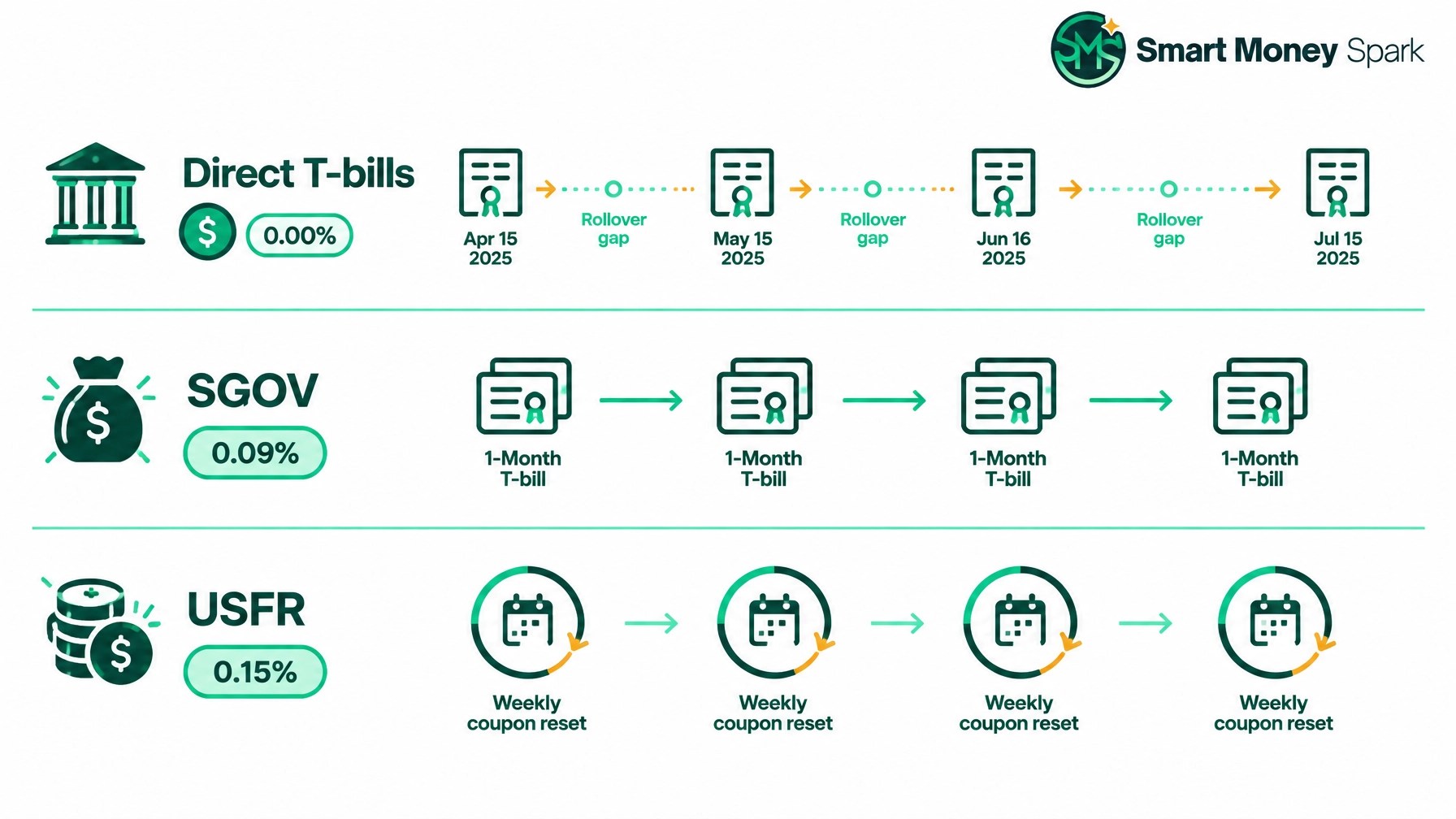
Direct bills have no fund fee but require a reinvestment plan; ETFs charge fees in exchange for simpler ongoing management.
A useful starting comparison:
| Option | Fund fee | Main convenience | Main trade-off |
|---|---|---|---|
| Direct T-bills | 0.00% | Choose a maturity and lock in its yield to maturity | You manage maturities and reinvestment |
| SGOV | 0.09% | Exposure to a changing portfolio of very short bills | Yield changes as bills mature and are replaced |
| USFR | 0.15% | Treasury income with a weekly-resetting coupon structure | Higher fee and different rate-reset behavior |
A bill’s yield to maturity is the annualized return implied by its purchase price and the amount paid at maturity, assuming you hold it to maturity. It is fixed for that bill, but the rate on a new bill may be different.
2. Structural Mechanics: 0–3 Month Fixed T-Bills (SGOV) vs. Weekly Floating Rate Notes (USFR)
SGOV tracks the ICE 0–3 Month US Treasury Securities Index and holds Treasury bills that generally mature within three months. As of November 5, 2026, iShares reported a 0.11-year effective duration and a 0.12-year weighted-average maturity for SGOV. The fund’s 30-day SEC yield was 3.83% on that date; this standardized measure is not a promise of future income. See the SGOV fund page for updated figures.
USFR tracks the Bloomberg U.S. Treasury Floating Rate Bond Index and holds Treasury floating-rate notes, or FRNs. Government debt with interest rates that reset over time. These notes have longer stated maturities than SGOV’s bills, but their coupons reset weekly based on a 13-week Treasury-bill auction rate plus a fixed spread. WisdomTree reported USFR’s effective duration at 0.02 years and its 30-day SEC yield at 3.98% as of November 6, 2026. Check the USFR fund page for current information.
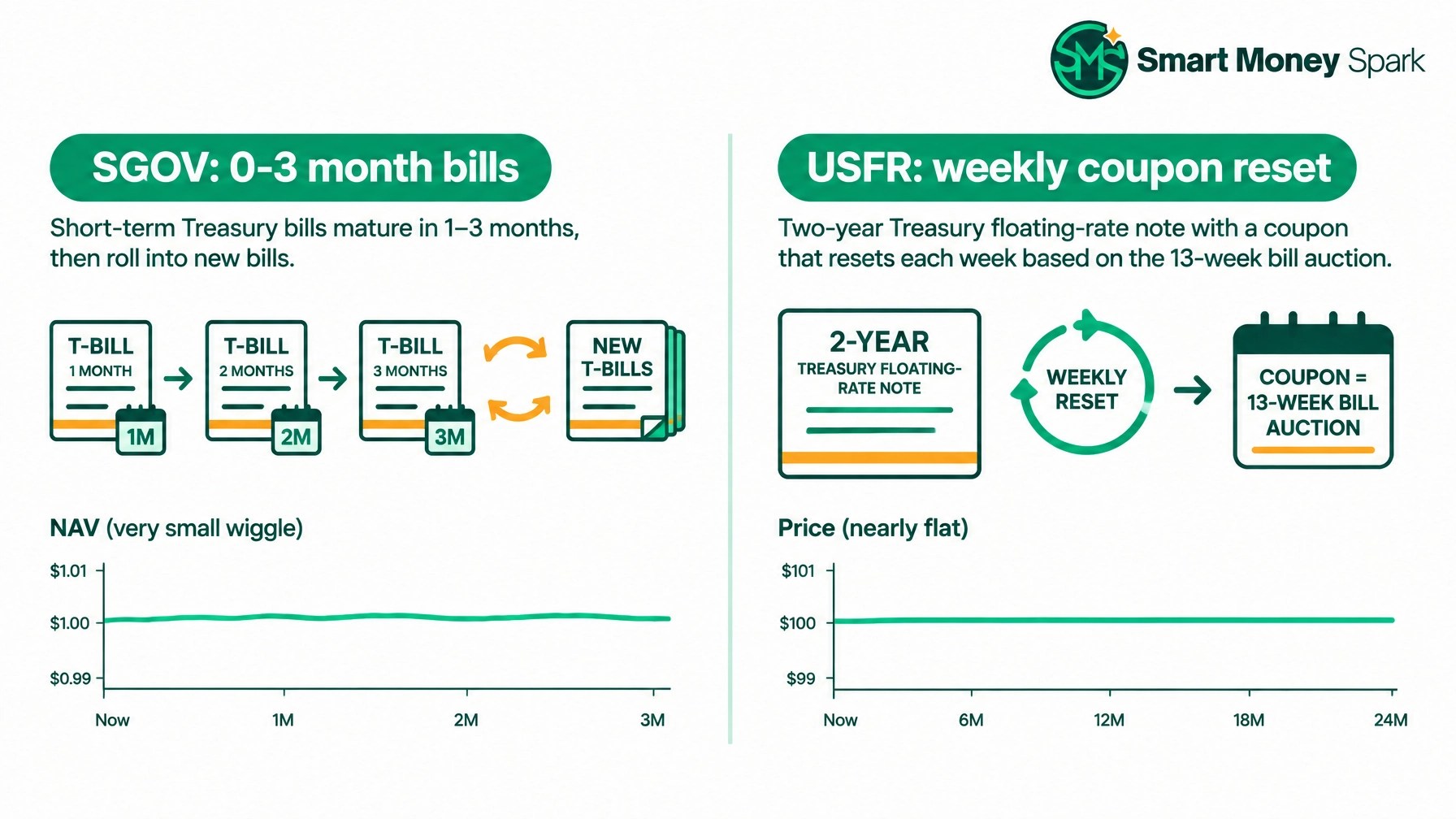
SGOV refreshes exposure through short-maturity bills; USFR’s FRN coupons reset weekly.
A discount rate is a way of quoting the difference between a bill’s purchase price and its face value at maturity. As short-term rates change, SGOV’s holdings gradually mature and are replaced at new rates. Its short duration limits, but does not eliminate, price movement. USFR’s weekly coupon reset helps keep its price less sensitive to rate changes, though its income can adjust more quickly when rates fall.
In plain terms: SGOV is more directly tied to very short fixed-rate bills; USFR’s income responds more frequently to its floating-rate benchmark. A higher current yield on one fund doesn’t guarantee it will stay ahead.
3. The State Tax Exemption Reality: 100% Direct Backing vs. ETF Year-End Reporting (95%+)
Interest from direct U.S. Treasury obligations is generally exempt from state and local income taxes under federal law, including 31 U.S.C. § 3124. TreasuryDirect says bill interest is subject to federal tax, not state or local tax. Direct bill interest is generally reported as Treasury interest on Form 1099-INT; confirm the form and box details with your broker or tax preparer.
ETF tax reporting takes an extra step. Funds generally report distributions on Form 1099-DIV. The portion potentially eligible for a state-tax adjustment depends on the fund’s holdings, the applicable annual tax supplement, and your state’s rules. Don’t assume that every dollar of an ETF distribution qualifies just because the fund holds Treasuries.
As a reference, iShares reported that 95.14% of SGOV’s 2025 income came from U.S. government obligations. That category can include certain federal-agency obligations, so it is not automatically the precise share of income that qualifies under every state’s rules. WisdomTree reported approximately 99.95% for USFR’s 2025 ordinary income in its tax discussion. These are past-year figures, not guarantees for another year. Check the fund sponsor’s final supplement and the requirements for your state; some states apply additional tests.
New York readers should also check how state and local rules apply to their own return. Before allocating idle balances to ETFs, check whether your uninvested brokerage cash is already earning a competitive rate in its default sweep.
4. Execution Velocity & Secondary Liquidity: Intraday ETF Spreads vs. T-Bill Auctions
SGOV and USFR trade on an exchange during market hours, so you can place a trade without waiting for a Treasury auction. Check the live bid-ask spread and use a limit order if appropriate; trading costs, market conditions, and brokerage fees can affect your result. ETFs generally settle on the standard T+1 cycle, one business day after the trade, so an intraday sale is not the same as settled cash immediately available for withdrawal.
Direct bills can be bought at Treasury auctions or in the secondary market. A non-competitive bid lets you accept the auction’s yield rather than specify one; the trade-off is that you don’t know the final rate until the auction result. TreasuryDirect lists bills from four weeks to 52 weeks, with a $100 minimum purchase. Auction dates and settlement schedules matter if you need the funds by a particular day. See TreasuryDirect’s bill overview and auction information.
Investors looking to avoid ETF expense ratios can buy bills through a brokerage instead of TreasuryDirect. Selling a bill before maturity may result in a gain or loss, depending on market prices.
5. Income Frequency & Cash Flow Timing: Monthly Dividend Sweeps vs. Discount Maturity Payouts
SGOV distributes income monthly, according to iShares. USFR also makes periodic fund distributions; check WisdomTree’s current distribution schedule. Your broker may let you reinvest ETF distributions automatically, but timing and fractional-share features vary by platform.
With a direct T-bill, you generally buy at a discount or at face value and receive the face value at maturity. TreasuryDirect describes bill interest as the difference between what you paid and what you receive at maturity. That can make bills useful when you want a known maturity date, but the cash flow is less like a regular monthly payment.
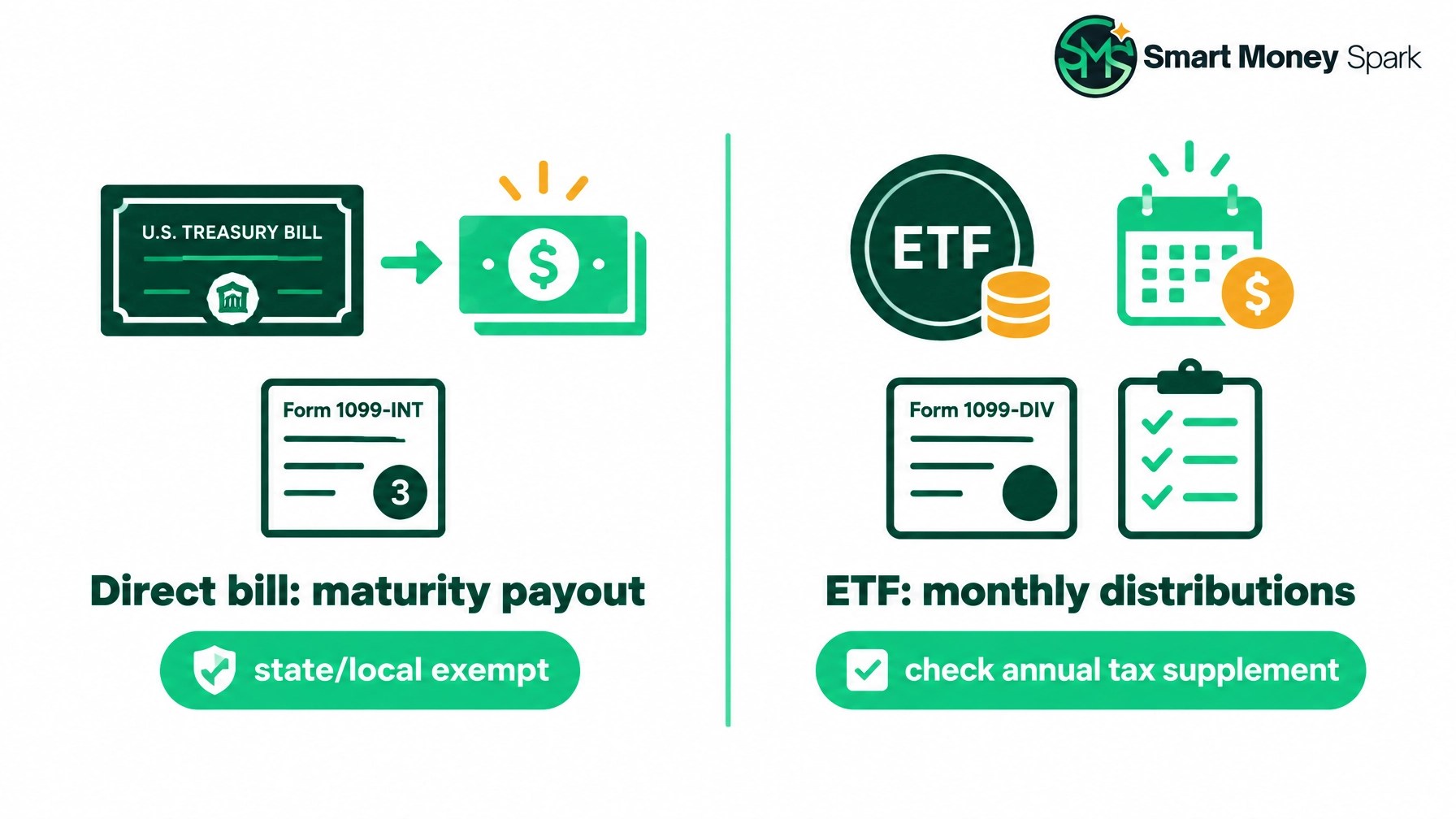
Direct bills typically pay at maturity; ETFs distribute income periodically and may require an annual tax-supplement check.
Worked Financial Allocation Example: Comparing Realized Net Return on a $100,000 Cash Allocation
This example uses a hypothetical 4.50% three-month Treasury yield, 32% federal tax bracket, and 9.30% state tax bracket. It assumes 96% state-exempt income for SGOV and 99.50% for USFR. Those percentages and rates are inputs to the calculation, not current quotes or predictions.
| $100,000 allocation | Direct 3-month T-bills | SGOV | USFR |
|---|---|---|---|
| Gross yield assumption | 4.50% | 4.50% | 4.50% |
| Expense ratio | 0.00% | 0.09% | 0.15% |
| Annual income after fund fee, before tax | $4,500.00 | $4,410.00 | $4,400.00 |
| Federal tax at 32% | $1,440.00 | $1,411.20 | $1,408.00 |
| State tax in example | $0.00 | $16.41 | $2.05 |
| Estimated annual after-tax income | $3,060.00 | $2,982.39 | $2,989.95 |
| Estimated after-tax yield | 3.060% | 2.982% | 2.990% |
Under these assumptions, the difference between direct bills and SGOV is about $77.61 a year, or $6.47 a month. The difference between direct bills and USFR is about $70.05 a year, or $5.84 a month. Actual results depend on yields, fees, tax rates, the final annual tax supplement, and applicable state tax rules.
Which option may fit your needs?
- Choose direct T-bills if you want to avoid a fund fee, prefer a maturity date you select, and are comfortable handling reinvestment.
- Consider SGOV if you want convenient exposure to very short Treasury bills and monthly fund distributions.
- Consider USFR if you want floating-rate Treasury exposure with frequent coupon resets and understand that its holdings have longer stated maturities than SGOV’s.
- Compare after-tax income, not just the headline yield, and check the current fund data and tax supplement before investing.
Key takeaways and next step
- Direct bills have no ETF expense ratio and generally have clear state and local tax treatment, but require maturity planning.
- SGOV holds very short bills; USFR holds longer-maturity FRNs with weekly coupon resets.
- ETF distributions may qualify for state-tax treatment only in part; verify the annual supplement and your state’s rules.
- Before choosing, compare current yields, fees, cash-access timing, and tax treatment for your own situation.
Next step: Check current fund data and your brokerage’s bill-auction and reinvestment options, then compare the expected after-tax income for the amount and time period you actually need.
Smart Money Spark’s financial education draws on Corey Friedrich’s experience in mortgage, real estate, and consumer financial education.
This article is educational information, not individualized financial advice. Tax rules and investment values can change; consult a qualified tax professional about your circumstances.