
Two common places for uninvested cash, with different yields, access, and protections.
Brokerage Cash Sweep vs. High-Yield Savings Accounts: Where Should Your Uninvested Cash Sit?
Your brokerage account may show a cash balance, but that money could be sitting in a bank deposit, a money market mutual fund, or another settlement option. The difference can affect your yield, insurance coverage, taxes, and how quickly you can use the cash.
A cash sweep is a service that moves idle account cash into a designated bank deposit or investment. The default option is convenient, but it is not always the best fit for your needs.
| Cash option | Typical benefit | Main trade-off |
|---|---|---|
| High-yield savings account (HYSA) | FDIC-insured bank deposit; easy to understand | Moving money to a brokerage may take time |
| Bank sweep | Cash stays connected to your brokerage; may qualify for FDIC coverage | Rates vary and can be low |
| Money market mutual fund | May offer a competitive short-term yield inside a brokerage | Not FDIC-insured; value and yield are not guaranteed |
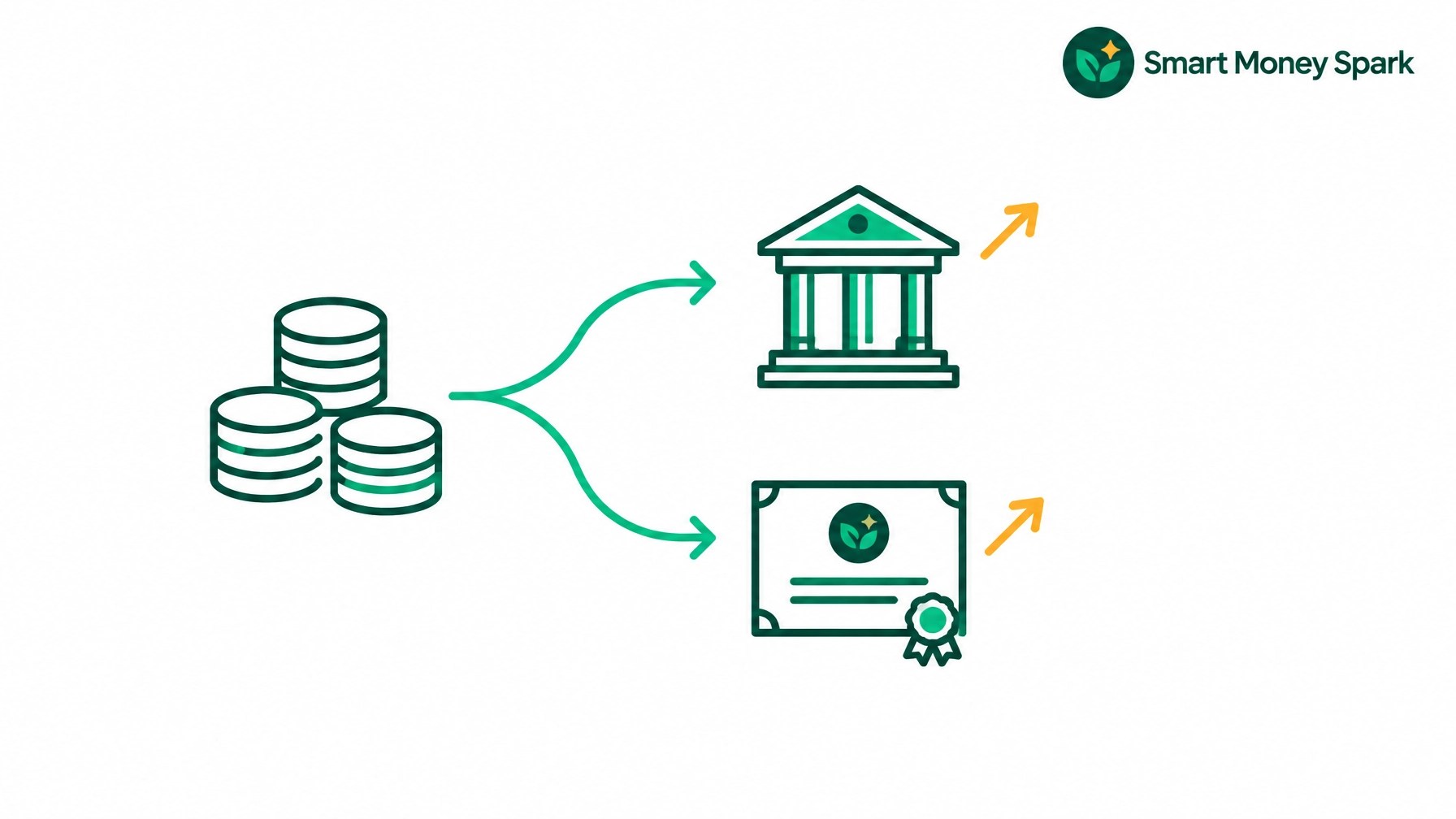
Illustration: Brokerage cash can be routed to a bank deposit or a money market fund.
1. The Anatomy of a Cash Sweep: Default Positions vs. Active Money Market Funds
A core position is the default place where a brokerage holds cash for transactions and uninvested balances. Depending on the account, it may be a bank deposit sweep or a money market mutual fund.
These choices are not interchangeable. A bank sweep is a deposit at one or more program banks; a money market fund is an investment in short-term securities. Check your account’s current cash feature and rate rather than assuming the brokerage automatically selects the highest-yielding option.
For example, Fidelity lists SPAXX, its Government Money Market Fund, as an available core position for eligible accounts. Its published 7-day yield was 3.57% on November 6, 2026. Vanguard’s VMFXX, the Vanguard Federal Money Market Fund, showed a 3.89% 7-day SEC yield on the same date. These yields change, and an account’s default options can depend on account type.
By contrast, some brokerage accounts use bank deposit sweeps as their default. E*TRADE’s published Bank Deposit Program rate table listed 0.01% APY for many balance tiers as of the research date. Schwab’s rates vary by cash feature and account; check the specific rate in your account disclosures. A quoted rate such as 0.45% should be treated as an example, not a universal current rate.
Before leaving uninvested funds in default accounts, align your balances with a short-duration Treasury ladder to capture peak short-term rates.
2. Yield Disparities: Bank-Affiliated Sweeps (0.45%) vs. Government Paper (4.50%+)
A low default rate can quietly cost you interest. Brokerages may earn a net interest margin (NIM). The difference between what they earn on cash and what they pay customers. That does not mean every low rate reflects the same business model, but it does mean you should compare the rate with alternatives.
As a dated snapshot, Fidelity’s SPAXX yield was 3.57% and Vanguard’s VMFXX yield was 3.89% on November 6, 2026. Meanwhile, E*TRADE’s rate table listed 0.01% for many standard deposit-sweep tiers. Rates are variable, not promises. HYSA rates also vary; the 4.25% rate in the example below is an assumed rate for comparing options, not a claim about every bank’s current offer.
Depositors unaware of broker-dealer net interest margins often overlook how much idle cash allocation matters, losing interest year after year.
Government money market funds seek to keep a stable net asset value (NAV), the per-share value of a fund, often at $1.00. Under Rule 2a-7, a government money market fund must invest at least 99.5% of its assets in cash, government securities, and/or qualifying repurchase agreements. The stable NAV is an objective, not a guarantee, and the fund is not a bank account.
3. The Multi-Bank Insured Cash Sweep (ICS): Scaling FDIC Protection Past $250k
The standard FDIC limit is $250,000 per depositor, per FDIC-insured bank, for each account ownership category. Deposits in the same ownership category at the same bank are added together, so having multiple accounts at one bank does not automatically multiply coverage.
An insured cash sweep (ICS) program can distribute deposits among multiple participating banks. Some programs are designed to provide higher total FDIC coverage, but the actual amount depends on the program’s bank network, deposit allocation, ownership category, and your other deposits at participating banks.
Do not assume that every sweep offers $2.5 million or $5 million of coverage. Ask for the program’s current maximum, the list of participating banks, and how it accounts for deposits you already hold there. Read the disclosures to understand what happens if a program bank changes or your balance exceeds the available network capacity.
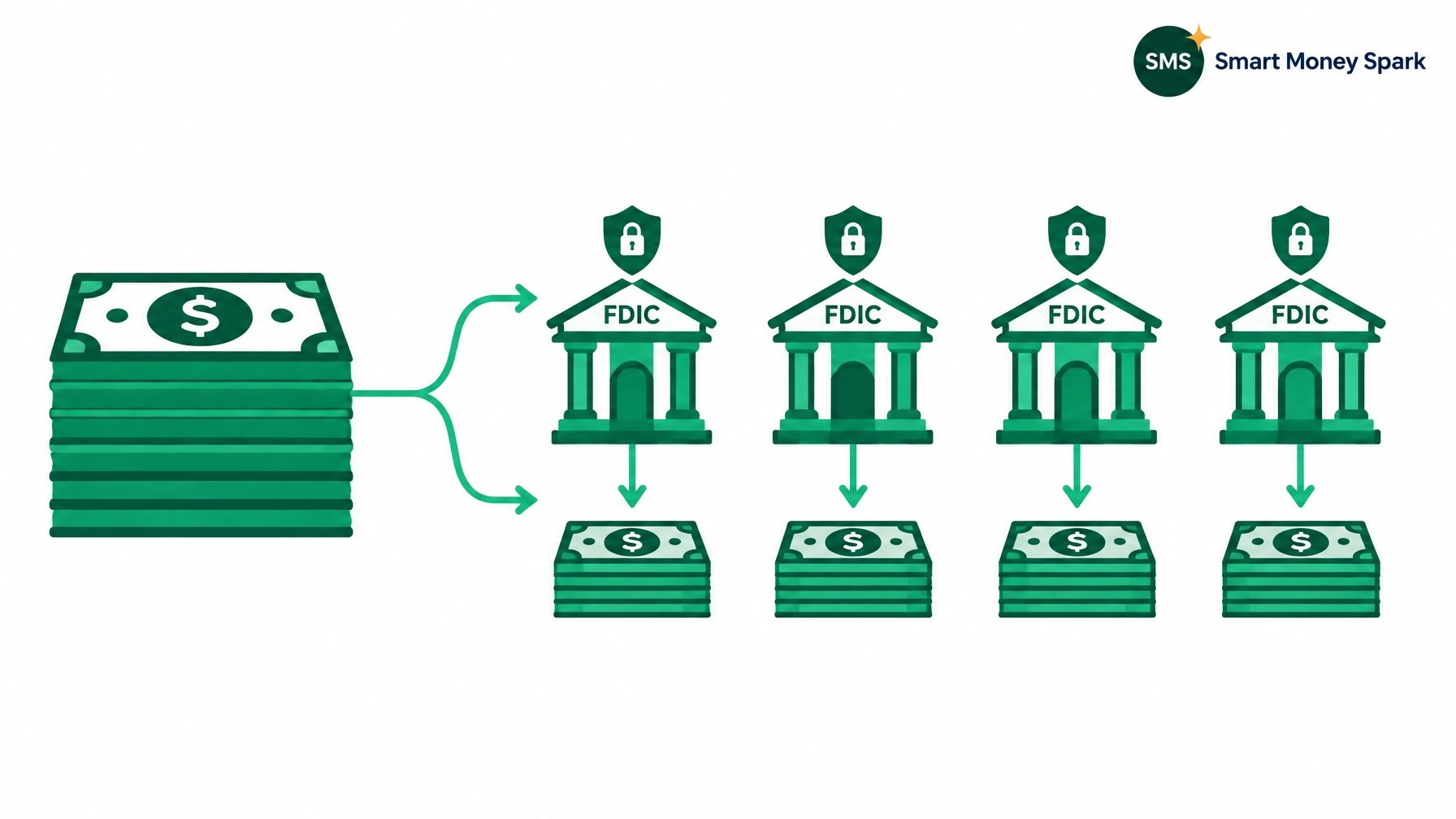
How an insured cash sweep works: one large balance split into smaller deposits across multiple FDIC-insured program banks, each within its own coverage limit.
4. SIPC vs. FDIC: Understanding Institutional Default Protections for Idle Reserves
A HYSA at an FDIC-insured bank is a deposit account. A money market mutual fund held in a brokerage account is an investment security, not an insured bank deposit.
SIPC may help customers recover missing cash and securities if a SIPC-member brokerage fails. Its protection limit is generally $500,000 per customer, including a $250,000 limit for cash claims. SIPC does not protect against a money market fund losing value or guarantee that its NAV will stay at $1.00.
That distinction matters: FDIC coverage protects eligible deposits if an insured bank fails; SIPC addresses missing customer property in a qualifying brokerage liquidation. Neither one protects you from every type of loss.
Deciding how much cash to retain in an instant sweep versus term instruments should be anchored to emergency fund sizing rules tailored to your recurring liabilities.

Illustration: FDIC insurance and SIPC protection apply to different kinds of accounts and risks.
5. Operational Velocity: T+1 Settlement, Trade Auto-Liquidation, and ACH Friction
ACH (Automated Clearing House) is an electronic network used for many bank transfers. Moving money from a HYSA to an investment account can take one to three business days, depending on the institutions, transfer method, and account review.
A brokerage cash position can be more convenient if you plan to trade: some accounts automatically use eligible core cash to fund a purchase. But do not assume every sweep works the same way or that all proceeds are immediately available. Check the brokerage’s rules for buying securities with cash, including any restrictions on unsettled funds.
The standard settlement cycle for most U.S. securities trades is T+1. The trade date plus one business day. This timing can affect when sale proceeds formally settle; it does not mean every transfer or cash withdrawal is instant. Review the broker’s rules and the SEC’s investor guidance on T+1.
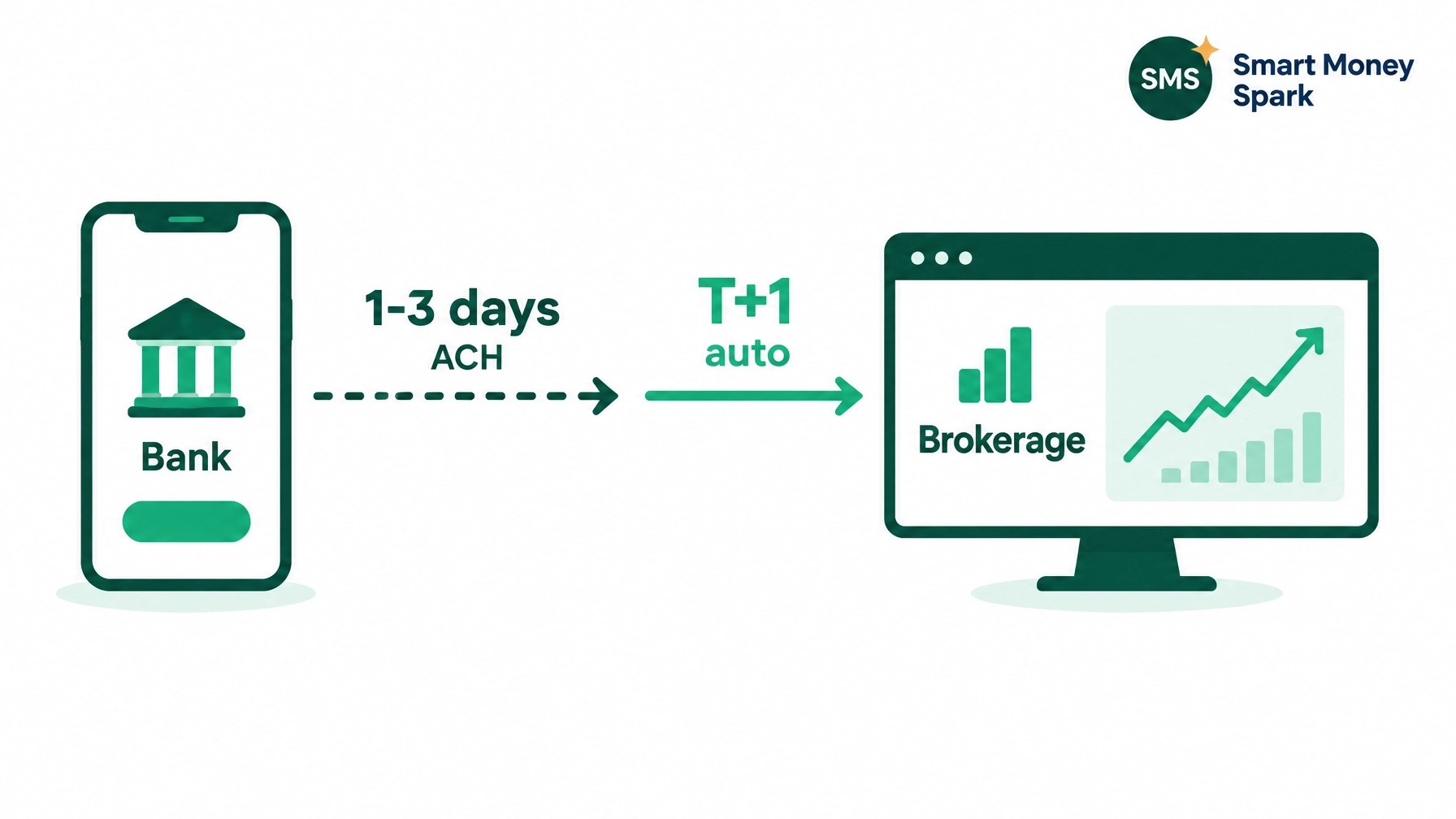
Moving cash from a bank can take one to three business days by ACH, while brokerage cash is ready to invest on settlement day.
Worked Underwriting Calculation: Net Yield & Tax Drag Analysis on a $150,000 Cash Position
The table below uses hypothetical rates and simplified marginal tax assumptions for a New York resident. Actual yields, tax treatment, fund distributions, and your tax bracket can differ. Bank interest is generally subject to federal and state income tax; some money market fund income attributable to qualifying U.S. government obligations may be exempt from state tax. Verify the fund’s annual tax information and New York rules before relying on that treatment.
| Illustrative option | Assumed yield and gross income | Estimated tax | Estimated net income |
|---|---|---|---|
| A. Default bank sweep | 0.45%; $675.00/year | $262.24, using 38.85% combined marginal rate | $412.76/year (about 0.28%) |
| B. Online HYSA | 4.25%; $6,375.00/year | $2,476.69, using 38.85% combined marginal rate | $3,898.31/year (about 2.60%) |
| C. Treasury-backed money market fund | 4.75%; $7,125.00/year | $2,377.61 estimated total tax | $4,747.39/year (about 3.16%) |
Assumptions: $150,000 cash balance; 32.00% federal marginal bracket; 6.85% New York state marginal bracket. For Option C, the example assumes 80% of income qualifies for state tax exemption: $5,700 of the $7,125 gross income. The remaining $1,425 is taxed at 6.85%, or $97.61; federal tax at 32% is $2,280.
Under these assumptions, Option C nets about $849.08 more per year than Option B and about $4,334.63 more than Option A. The supplied comparison figure for Option C versus A is $4,334.62; using the stated rates and rounding to cents gives $4,334.63. This is an illustration, not a forecast. A fund’s actual U.S. obligation percentage and the portion eligible for state tax treatment can vary.
Key Takeaways
- Look up the exact default cash position and current yield in your brokerage account.
- A bank sweep or HYSA may offer FDIC insurance; a money market mutual fund does not.
- Multi-bank sweep coverage depends on program terms and your deposits at participating banks.
- Compare after-tax yield, access, and protection, not just the headline rate.
Your next step: Check your brokerage’s cash feature, current rate, insurance disclosures, and transfer rules. Then compare it with a HYSA and any available money market fund using your own tax situation.
This is educational information, not individualized financial advice.
Smart Money Spark shares practical personal-finance education informed by Corey Friedrich’s experience in mortgage lending, real estate, and financial education, including a New York perspective.