

Seven simple visual cues show different ways to organize and manage your money.
The most popular budgeting methods include the 50/30/20 rule, zero-based budgeting, the cash envelope system, and pay yourself first, along with a few variations. The best method is the one that fits your income pattern and personality, and that you’ll actually keep up.
What are the 7 budgeting methods?
A budget gives your money a plan. Some methods divide it into broad percentages, while others track each dollar or rely on automatic transfers. Here’s a quick comparison.
| Method | Core rule | Best for | Effort level | Main drawback |
|---|---|---|---|---|
| 50/30/20 rule | Divide take-home pay into needs, wants, and savings/debt | People who want a simple guide | Low | Percentages may not fit your costs |
| Zero-based budgeting | Assign every dollar a job | Detail-lovers and people managing tight cash flow | High | Needs regular upkeep |
| Cash envelope system | Set spending limits by category, often using cash | People who overspend with cards | Medium | Cash is awkward for online bills |
| Pay yourself first | Save before spending on other things | People who dislike tracking | Low | Other costs may be underfunded |
| 60% Solution | Keep committed expenses to about 60% of gross income | People who want fewer buckets | Low–medium | The gross-income formula can be confusing |
| Values-based budget | Automate savings toward your priorities | Minimalists | Low | Small costs can drift without check-ins |
| No-budget budget | Automate bills and savings; spend what remains | Busy people with predictable finances | Low after setup | Poor estimates can leave you short |
How does each method work?
1. The 50/30/20 rule
What it is: Divide your take-home pay into 50% for needs, 30% for wants, and 20% for savings and debt payoff. It’s a guideline, not a strict rule.
Who it fits: You want a quick way to check whether your spending broadly matches your priorities. Main drawback: High housing or medical costs can make the needs target unrealistic.
Example: On $4,000 a month, that’s $2,000 for needs, $1,200 for wants, and $800 for savings and debt.
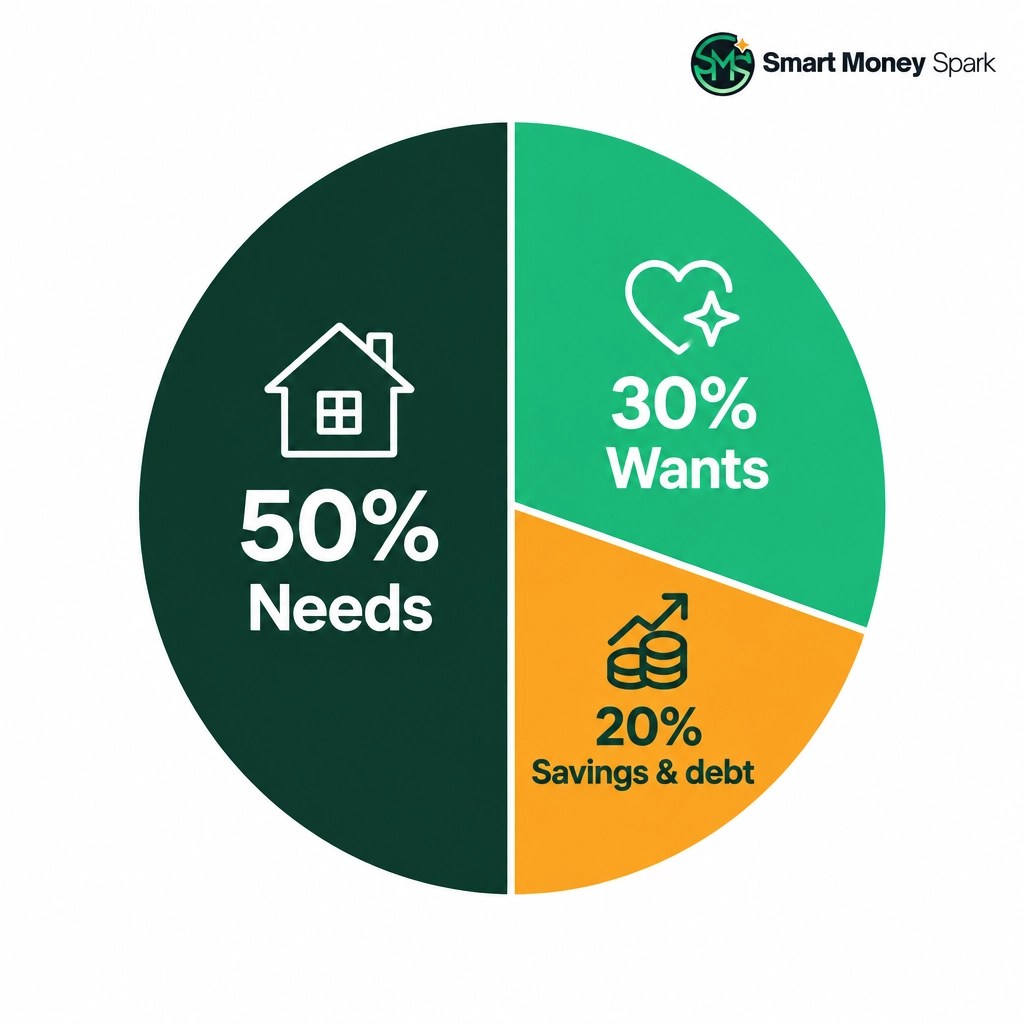
The 50/30/20 rule offers a broad starting point; adjust the percentages to fit your real costs.
2. Zero-based budgeting
What it is: Assign every dollar a purpose until income minus planned spending, saving, and debt payments equals zero. Zero doesn’t mean spending everything: savings and investments count as jobs for your money, too. Budgeting tools such as YNAB use this kind of planned, category-by-category approach. See Chase’s guide to zero-based budgeting.
Who it fits: You like detail or want to make deliberate choices about where each dollar goes. Main drawback: It takes time to set up and maintain.
Example: With $4,000 in take-home pay, assign $2,000 to needs, $1,000 to wants, $600 to savings, $300 to debt payoff, and $100 to car repairs. The plan totals $4,000.
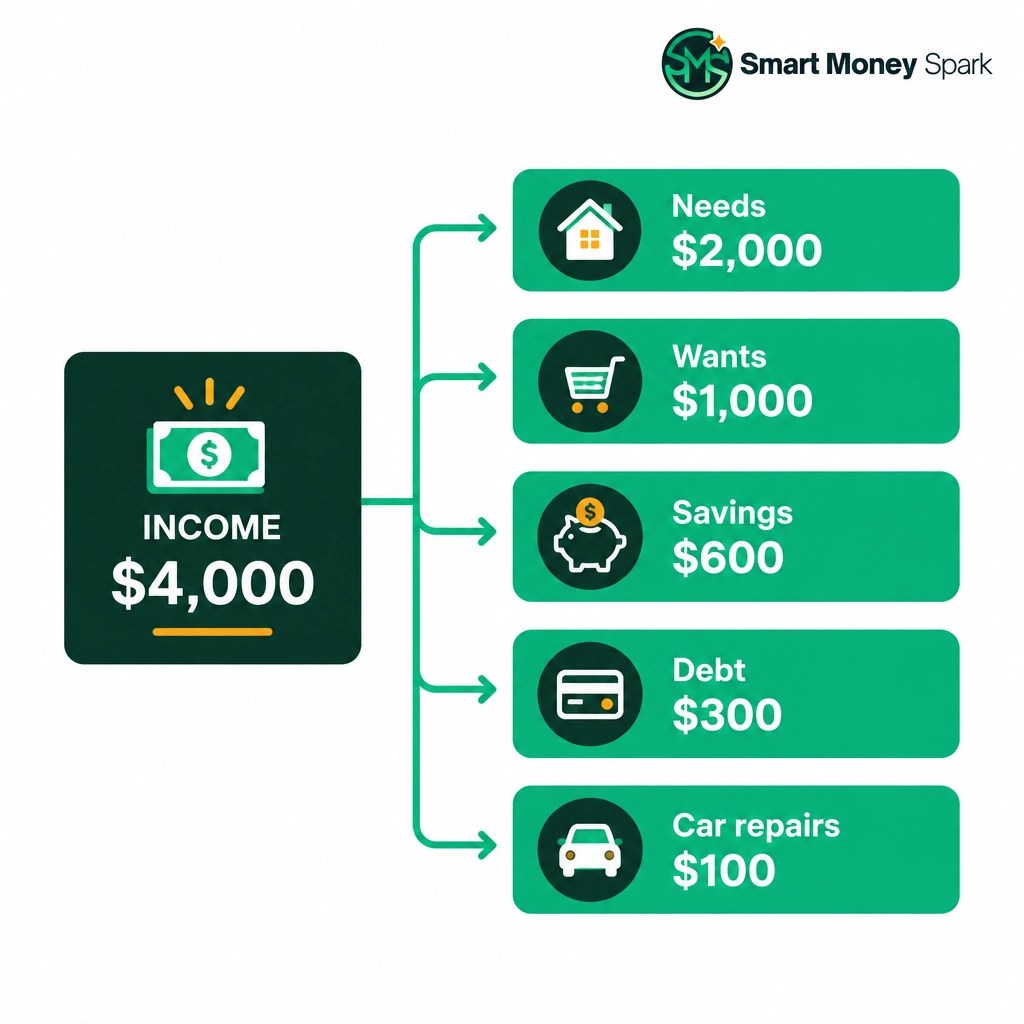
In a zero-based plan, the assigned amounts add up to all your income.
3. The cash envelope system
What it is: Set aside money for selected categories in labeled envelopes; when one is empty, pause spending in that category or consciously move money from another one.
Who it fits: You tend to overspend on things like dining out or groceries when you pay by card. Main drawback: Cash is inconvenient for online purchases and regular bills. You can use separate digital spending buckets instead. Fidelity explains how cash-stuffing envelopes work.
Example: From $4,000 a month, you might set aside $500 for groceries and $150 for dining out. When the dining envelope is empty, you wait until next month or choose to move money from another category.
4. Pay yourself first
What it is: Automatically move money to savings or investments when you get paid, before spending on other things.
Who it fits: You want to save consistently without tracking every purchase. Main drawback: Saving first doesn’t automatically make your remaining spending plan realistic; you still need enough for bills and irregular costs.
Example: On $4,000 a month, transfer $400 to savings on payday, then plan the remaining $3,600 for bills and spending. Investor.gov recommends including saving and investing in your plan and notes that automatic deposits can make it easier to follow through. Read its budgeting guidance.
5. The 60% Solution
What it is: Richard Jenkins’s framework divides gross income, income before taxes and deductions, into 60% for committed expenses and four 10% buckets: retirement, long-term savings or debt, irregular expenses, and fun. The 60% Solution guide explains the approach.
Who it fits: You want fewer categories and a broad limit for recurring costs. Main drawback: It uses gross income, so it doesn’t compare directly with methods based on take-home pay. Treat its percentages as a framework, not a universal target.
Example: With $5,000 gross monthly income, the plan sets aside $3,000 for committed expenses and $500 each for retirement, long-term savings or debt, irregular expenses, and fun.
6. Values-based budgeting (the anti-budget)
What it is: Choose the goals that matter most, automate contributions toward them, and spend less time tracking small categories.
Who it fits: You prefer a simple plan built around priorities rather than detailed limits. Main drawback: It can drift if you don’t check that your spending still supports your goals.
Example: From $4,000 take-home pay, you might automatically direct $500 to an emergency fund and $300 to a retirement account, then review bills and spending once a month.
7. The no-budget budget
What it is: Automate bills, savings, and investments around payday, then spend what remains.
Who it fits: You’re busy, your income is predictable, and you can keep enough money in your account for bills. Main drawback: If your automatic transfers are too high, or you forget annual costs, you can end up short.
Example: From $4,000 take-home pay, automate $1,900 for bills, $400 for savings, and $200 for investments. That leaves $1,500 for other spending, assuming irregular costs are already accounted for.
Which budgeting method is best for beginners?
The 50/30/20 rule is a good starting point if you want simple targets without tracking every purchase. If you’d rather focus on consistency than categories, try pay yourself first. If you need to know exactly where your money is going, zero-based budgeting offers more control, but it requires more attention.
No approach has to fit perfectly on day one. Use your actual bills and spending to adjust any starting percentages.
What if my income changes every month?
Start with a cautious estimate based on a lower-earning month rather than counting on your best month. Prioritize essentials and minimum debt payments, then direct extra income toward irregular costs, savings, or additional debt payoff when it arrives.
Review the plan whenever your income changes. The Consumer Financial Protection Bureau’s budgeting guidance recommends tracking income and spending and updating your budget as circumstances change.
Can you combine methods?
Yes. These methods are tools, not mutually exclusive systems. For example, you could use zero-based budgeting to plan the month, automate savings on payday, and set a cash or digital limit for dining out.
A budget can also free up monthly cash for longer-term goals. Once you’ve covered near-term needs and built a plan for your surplus, explore Smart Money Spark’s retirement guides to learn about putting that money to work.
How do you pick one?
Choose based on what you want the budget to do:
- Want a quick framework? Try 50/30/20.
- Need more control over each dollar? Try zero-based budgeting.
- Overspend in a few categories? Try cash or digital envelopes.
- Want to build a saving habit? Automate pay-yourself-first transfers.
- Prefer less tracking? Try a values-based or no-budget budget.
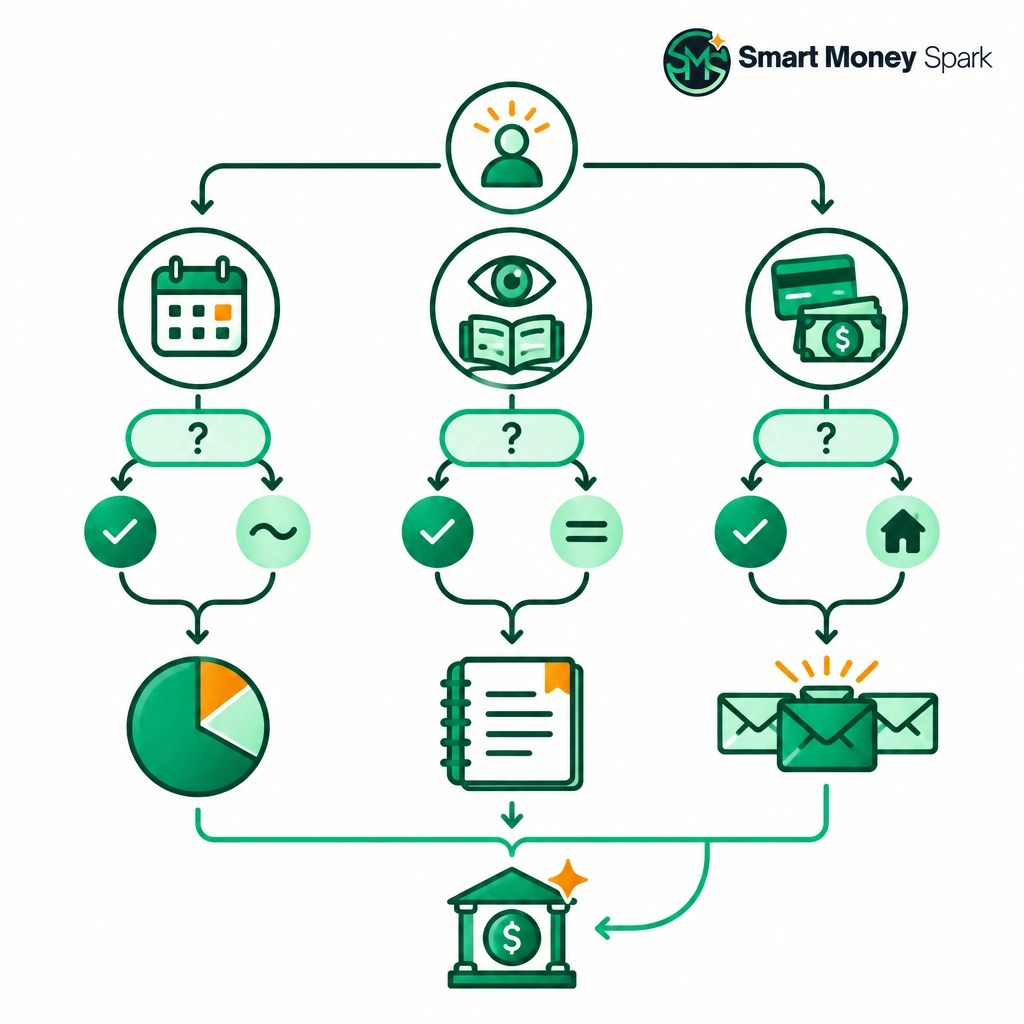
Your income pattern, tracking preference, and spending habits can help narrow down a method.
What is the most popular budgeting method?
The 50/30/20 rule is widely recognized because it’s easy to remember. Zero-based budgeting, envelopes, and automatic saving are also common approaches, each suited to different habits and needs.
Is zero-based budgeting hard?
It can take more time than a percentage-based plan because you assign and review individual categories. Start with your main bills, spending, savings, and debt payments, then refine the plan as you learn what needs attention.
What’s the simplest budgeting method?
Pay yourself first is simple to set up: arrange an automatic savings transfer, then use a basic plan for your bills and spending. It’s still important to account for irregular expenses so they don’t catch you off guard.
Can I use the 50/30/20 rule with an irregular income?
Yes, but use a cautious income estimate and adjust the amounts as money comes in. You can also use percentages as a guide rather than a fixed monthly rule.
Key takeaways
- The best budgeting method is one you can maintain.
- Use 50/30/20 for broad targets and zero-based budgeting for detailed control.
- Automate savings if consistency is your biggest challenge.
- Make room for irregular costs, not just monthly bills.
Next step: Pick one method, try it for 30 days, and adjust it based on what actually happens. For more practical money guides, visit Smart Money Spark.
Smart Money Spark’s financial education draws on Corey Friedrich’s background in mortgage, real estate, and consumer financial education, with a practical local perspective.
This article is educational information, not individualized financial advice.